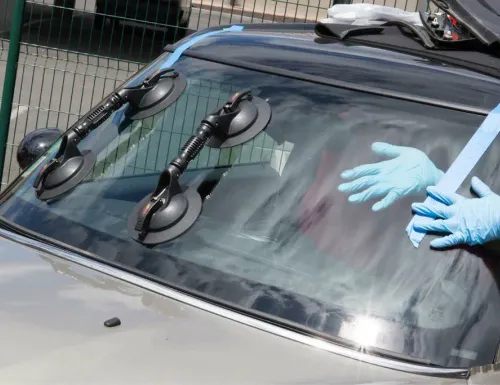
Windshield replacement in Atlanta starts at $199 at Glass Inc, and a chip repair is a flat $49 no matter what you drive. Between those two numbers sits a wide range, and the make of your vehicle explains most of it. Not the badge itself, but what the manufacturer built into the glass: forward-facing ADAS cameras, acoustic lamination, head-up display projection zones, rain sensors, heating elements, and embedded antennas. A 2012 Corolla with plain laminated glass and a 2024 Tesla with a camera cluster behind the mirror are two different jobs, even though the installation steps look similar from the driveway.
This guide is the master index for every vehicle-make windshield guide we have published. Below you will find a comparison table covering each make, a plain explanation of what drives the price for each group of vehicles, and links to the dedicated guide for your car. If you already know your VIN, skip ahead and run it through our free VIN lookup tool, which identifies your exact glass configuration before you talk to anyone.
Glass Inc has been installing glass in Atlanta since 1956. Call us at (404) 873-6991 for a quote on any make listed here.
What actually changes the price from make to make
Four features account for nearly all of the price spread between vehicle makes:
- ADAS cameras. A forward-facing camera mounted behind the windshield powers lane keeping, automatic emergency braking, and adaptive cruise. Replace the glass and the camera must be recalibrated ($150-$400, and we include it in your quote). Almost every vehicle built after 2018 has one.
- Acoustic glass. A sound-damping vinyl layer inside the laminate. Standard on German luxury makes and most EVs, optional on many mainstream trims. It costs more to manufacture, so it costs more to replace.
- Head-up display (HUD). HUD windshields use a special wedge-shaped interlayer so the projected image does not ghost. The glass is model-specific and cannot be substituted with a non-HUD part.
- Rain sensors, heating, and antennas. Individually small, but they multiply the number of possible part variants for a single model. This is why two owners of the same car can get different quotes, and why the VIN settles the question.
Windshield cost drivers by make: the full comparison
Every make in this table has its own dedicated Atlanta guide. The links go to real posts with model-specific detail.
| Make | What drives the price | Typical extra cost drivers | Dedicated guide |
|---|---|---|---|
| Tesla | Autopilot camera cluster, acoustic glass on all models | Camera recalibration, large single-piece glass on some models | Model 3, Model Y, Model S, Model X, Cybertruck |
| Rivian | Camera-dense driver assistance suite | Recalibration, limited aftermarket glass supply | Rivian guide |
| Mercedes-Benz | HUD on many trims, acoustic glass standard | Wedge-interlayer HUD glass, camera recalibration | Mercedes-Benz guide |
| BMW | HUD availability across the lineup, acoustic glass | HUD-specific part numbers, recalibration | BMW guide |
| Porsche | Acoustic glass, tight OEM fitment tolerances | Model-specific glass, recalibration on newer cars | Porsche guide |
| Audi | HUD trims, acoustic glass, camera-based assists | HUD glass variants, recalibration | Audi guide |
| Land Rover | Heated windshields common, camera assists | Heating elements, acoustic glass, recalibration | Range Rover guide |
| Lincoln | Co-Pilot360 camera, acoustic glass on most trims | Recalibration, HUD on some models | Lincoln guide |
| Ram | Large truck glass, camera on newer model years | Glass size, recalibration | Ram guide |
| Ford | Co-Pilot360 camera, many part variants per model | Recalibration, heated glass options | F-150, Fusion |
| Chevrolet | Camera-based safety suite on recent years | Recalibration, truck glass size on Silverado | Chevrolet guide |
| GMC | Shares GM camera hardware, large truck glass | Recalibration, HUD on Denali trims | GMC guide |
| Jeep | Upright Wrangler glass takes frequent rock hits | Camera on newer years, frequent replacement need | Wrangler guide |
| Dodge | Camera on later model years, performance trims | Recalibration where equipped | Charger, Challenger |
| Toyota | Toyota Safety Sense camera on nearly all recent cars | Recalibration, acoustic glass on hybrid trims | Camry, Corolla, Prius, RAV4 |
| Honda | Honda Sensing camera standard since the late 2010s | Recalibration, acoustic glass on upper trims | Accord, Civic, Odyssey |
| Nissan | Safety Shield 360 camera on recent model years | Recalibration where equipped | Altima, Sentra |
| Subaru | EyeSight stereo camera pair reads through the glass | Static and dynamic recalibration, glass quality matters more | Subaru EyeSight guide |
| Hyundai | SmartSense camera on most recent vehicles | Recalibration, heated glass options | Hyundai guide |
| Kia | Drive Wise camera suite on recent model years | Recalibration where equipped | Kia guide |
One note on Tesla: we also cover the brand broadly, but the Model 3 guide is the deepest and most current, so start there if you are unsure which page fits your car.
EVs: Tesla and Rivian
Electric vehicles sit at the expensive end of the range for two reasons. First, they are camera-dense. Tesla runs Autopilot primarily through cameras rather than radar, and the forward cluster sits directly behind the windshield glass. Any replacement means the cameras must be recalibrated so the car sees the road where the road actually is. Second, EV cabins are quiet, so manufacturers fit acoustic glass to keep wind and road noise from becoming the loudest thing in the car. Quiet glass is laminated glass with an extra damping layer, and it is priced accordingly.
Rivian adds a supply factor. The R1T and R1S are newer vehicles with a smaller aftermarket, so glass availability can affect both price and scheduling. Our Rivian guide covers what to expect. For Tesla owners, each model has its own page because the glass differs meaningfully between them, from the Model 3 sedan to the Cybertruck’s unusually large flat panel.
German luxury: Mercedes-Benz, BMW, Porsche, Audi
The German makes stack features. A single Mercedes E-Class windshield can carry a HUD projection zone, acoustic lamination, a rain and light sensor, a heated wiper park area, and the camera for the driver assistance suite, all in one piece of glass. Each feature narrows the list of correct part numbers, and HUD glass in particular cannot be swapped for the standard version. Install non-HUD glass in a HUD car and the projected speedometer shows a double image.
BMW and Audi follow the same pattern, with HUD offered across much of both lineups. Porsche adds tight fitment tolerances on sports models, where the glass follows a steep rake. The individual guides for Mercedes-Benz, BMW, Porsche, and Audi break down which trims carry which features. Land Rover belongs in this conversation too: the Range Rover guide covers heated windshields, which are common on the brand and add their own part variant.
Trucks and American muscle: Ram, Ford, Chevrolet, GMC, Jeep, Dodge
Truck windshields are big. More glass means more material, and the tall upright angle on a Ram or F-150 also catches more rocks on I-285 than a raked sedan windshield does. Newer trucks from all four domestic brands carry forward cameras, so the recalibration step applies to them the same as it does to a Tesla. GM trucks share camera hardware between Chevrolet and GMC, with HUD showing up on upper GMC trims.
The Jeep Wrangler deserves its own mention. That nearly vertical windshield takes hits constantly, which is why Wrangler owners replace glass more often than almost anyone else. On the car side, the Dodge Charger and Challenger ran long production cycles, so the price depends heavily on model year: early cars have simple glass, later ones add the camera. The Ford Fusion follows a similar year-dependent split.
Mainstream: Toyota, Honda, Nissan, Subaru, Hyundai, Kia
Mainstream does not mean simple anymore. Toyota made its Safety Sense camera standard across nearly the whole lineup years ago, and Honda did the same with Honda Sensing. A Camry, Corolla, RAV4, or Prius from the last several model years almost certainly needs recalibration after replacement. Same story for the Accord, Civic, and Odyssey. Nissan’s Safety Shield 360 appears on recent Altima and Sentra model years, while Hyundai and Kia run comparable camera suites under the SmartSense and Drive Wise names.
Subaru is the special case. EyeSight uses a stereo pair, two cameras up near the mirror, and the system reads the road through the windshield itself. The glass is effectively part of the sensor, so glass quality and precise recalibration matter more on a Subaru than on a single-camera car. Our Subaru EyeSight guide explains the static and dynamic calibration procedures in detail.
ADAS recalibration and why the VIN decides everything
Recalibration is the step that separates a modern windshield job from an old one. After the new glass goes in, the forward camera has to be re-aimed, either with a target board in the shop (static), a road drive at specified speeds (dynamic), or both. At Glass Inc the recalibration runs $150-$400 depending on the procedure your vehicle requires, and it is included in the written quote, never added afterward. Skipping it is not an option we offer: a camera that is off by a fraction of a degree reads lane lines and following distances wrong.
Here is the practical problem for you as an owner: a single model can have half a dozen windshield variants depending on trim, options, and build date. Guessing from the model name alone produces wrong quotes. The VIN does not guess. It encodes exactly which glass your vehicle left the factory with, sensors, HUD, heating, and all.
Run your VIN through our free VIN lookup tool before you book. It takes under a minute, identifies your exact glass configuration, and it is the same tool our own team uses to order the correct part the first time. You can also see our full pricing on the prices page or start with the windshield replacement service page for the step-by-step process.
Frequently asked questions
Why does the same crack cost more to fix on one car than another?
A chip repair does not vary: it is $49 at Glass Inc regardless of make, because the resin injection process is identical on a Kia and a Porsche. Replacement is where make matters. The price reflects the glass itself (acoustic lamination, HUD interlayer, heating elements, embedded antennas all add manufacturing cost) plus the labor that follows, chiefly ADAS recalibration on camera-equipped vehicles. Our floor is $199 for a straightforward windshield with no sensors. A camera-equipped luxury vehicle with HUD glass lands well above that because the part costs more and the recalibration procedure takes shop time and equipment. The honest answer to “what will mine cost” is always: run the VIN, then quote.
Does every new car really need recalibration after windshield replacement?
Nearly every vehicle built in the last several years carries a forward-facing camera behind the windshield, because automatic emergency braking became effectively standard equipment industry-wide by the 2022-2023 model years. If your car has lane keeping assist, adaptive cruise, or automatic braking, assume recalibration is required after glass replacement. The procedure runs $150-$400 and we include it in the quote up front. Exceptions exist: older vehicles without driver assistance, and some cars where those systems run purely on radar mounted in the grille. Your VIN tells us which situation applies, which is one more reason to check it first.
Are luxury and EV windshields covered differently by insurance?
Coverage works the same way across makes: comprehensive insurance typically handles glass claims, and your deductible determines whether a claim makes sense. What changes is the math. If your deductible is $500 and a mainstream sedan windshield costs less than that, paying cash is simpler. On a camera-equipped EV or a HUD-glass German car, the total can clear the deductible comfortably, and a claim usually makes sense. Georgia does not have a zero-deductible glass law like Florida, so check your policy language. We work with insurance claims regularly and can walk you through the paperwork when you call (404) 873-6991.
Can I put cheaper non-OEM glass on a car with cameras or HUD?
Sometimes, with conditions. Quality aftermarket glass exists for most mainstream camera-equipped vehicles, and when it meets the optical standards the camera needs, it calibrates fine and saves money. HUD is stricter: the projection requires a wedge-shaped interlayer, so the replacement must be a HUD-specific part whether OEM or aftermarket. Subaru EyeSight is the most demanding case, since the stereo cameras read the road through the glass and small optical distortions matter. Our position is straightforward: we quote the glass options that will actually calibrate on your specific vehicle, and we tell you when the cheaper option is fine and when it is not.
How do I find the right guide for my specific car?
Use the table above. Every make we service in Atlanta with a dedicated guide is listed there, and each link goes to a full article on that vehicle’s glass, sensors, and replacement process. Multi-model makes (Tesla, Toyota, Honda, Nissan, Ford, Dodge) have separate guides per model because the glass genuinely differs between them. If your make is not in the table, we almost certainly still service it: the guides cover the vehicles Atlanta drivers ask about most, not the limit of what we install. Start at our auto glass service page or call (404) 873-6991 and we will quote your vehicle directly. Side windows, for reference, run $100-$350 depending on the door and glass type.
Get your exact price
Seventy years of Atlanta glass work has taught us one thing about vehicle windshields: the make sets the range, but the VIN sets the price. Run yours through the VIN lookup, browse the full price list, or call (404) 873-6991. Chip repairs are $49 today, replacements start at $199, and every quote includes recalibration when your car needs it.