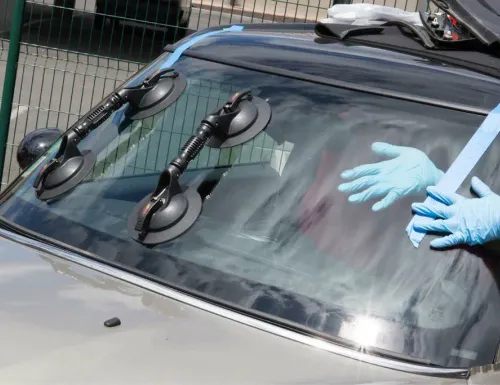
A Subaru with EyeSight is not a normal windshield job. The system reads the road through a pair of cameras mounted at the top of the windshield, which means the glass is part of the safety equipment. Swap the windshield and those cameras have to be recalibrated, or features like lane keeping and automatic braking can end up pointing at the wrong spot. Here is what Subaru owners in Atlanta should know before they book.
The short answer
- EyeSight sees the road through two cameras at the top of the windshield.
- Replace that windshield and the cameras must be recalibrated, static, dynamic, or both depending on the model.
- The glass itself matters, because the cameras look straight through it.
- Drive before calibration and EyeSight may switch off or read the road wrong. Treat it like the system is down.
What EyeSight is, and why the glass matters
EyeSight is Subaru’s driver-assist suite. It runs adaptive cruise control with lane centering, pre-collision braking, lane departure and sway warning, and on newer models automatic emergency steering. Most systems like this watch the road with a radar unit tucked behind the bumper. Subaru does it differently. EyeSight uses a stereo camera pair right behind the windshield, up near the mirror.
That design is the whole reason a Subaru windshield is a careful job. The cameras look through the glass, so the windshield is effectively part of the sensor. If the glass is off in thickness, curve, or clarity, the cameras see a slightly different road than the one in front of you.
Why recalibration is not optional
Pull a windshield out and set a new one in, and the cameras almost never land in the exact same spot to the millimeter. A tiny shift changes the angle they view the road at. Recalibration re-teaches the system where straight ahead actually is.
There are two kinds, and your Subaru may need one or both:
- Static calibration happens in the shop, with targets placed at measured distances in front of the car.
- Dynamic calibration happens on a road drive at set speeds, so the system can relearn against real lane lines.
Which one you need comes down to the model year and trim. A good shop checks Subaru’s procedure for your exact car rather than guessing.
Done properly, the install follows the auto glass industry’s safe-installation standard from the Auto Glass Safety Council, and the glass meets the federal motor vehicle safety standard for glazing, FMVSS 205. Those are the baselines a Subaru deserves, camera or no camera.
OEM versus aftermarket glass on an EyeSight Subaru
On a car with no windshield camera, a quality aftermarket windshield is usually fine. An EyeSight Subaru raises the bar. The camera has to read cleanly through the glass and mount to the right bracket, so the windshield needs to match Subaru’s optical and mounting spec. Glass that is close but not quite right is where calibrations fail and features act up.
We use OEM or OEM-equivalent glass built to that spec, so the cameras line up and calibrate the first time instead of fighting the install.
What a Subaru EyeSight windshield costs in Atlanta
A windshield for an EyeSight Subaru costs more than a basic one, and it should. You are paying for camera-grade glass plus the calibration that follows. AAA’s research on advanced driver assistance systems found that recalibrating these systems adds a real amount to repair bills, which is why an ADAS windshield and a no-frills windshield are not the same line item.
The exact number depends on your model, the glass, and whether calibration is static, dynamic, or both. Rather than quote a guess, we confirm it for your specific Subaru before any work starts. You can look up your windshield by VIN or see our pricing to get in the right ballpark first.
Does insurance cover EyeSight calibration?
Usually, yes. If your policy covers windshield replacement, the required recalibration is part of that same repair, not a separate bill you eat on your own. some comprehensive policies cover auto glass, and some cover it with no deductible. We bill your insurer directly and handle the claim paperwork, so the calibration does not turn into a fight over who pays. Confirm your coverage before the appointment and we will work it out with your carrier.
What goes wrong if you skip calibration
This is the part that makes EyeSight different from a plain windshield. Drive on an uncalibrated system and the cameras are reading the road from the wrong angle. Lane keeping can nudge you at the wrong moment. Pre-collision braking can fire late, or flag a threat that is not there. Adaptive cruise can misjudge the gap to the car ahead. None of that is a risk worth taking to save an hour, and it is exactly why Subaru builds calibration into the procedure.
How to tell your Subaru needs it
A few signs point to calibration after glass work:
- An EyeSight warning light or a message that the system is off.
- The cameras are visible at the top of the windshield, just behind the mirror. If yours has them, it has EyeSight.
- You just had the windshield replaced. On an EyeSight car, that alone is the trigger.
When in doubt, have it checked. A scan tool reads whether the system is calibrated and within spec.
Which Subarus have EyeSight
EyeSight shows up across the lineup, including the Outback, Forester, Crosstrek, Ascent, Impreza, Legacy, and WRX. It is standard on many 2019 and newer trims and optional on a good number of earlier ones. If you are not sure your Subaru has it, look for the cameras at the top of the windshield near the mirror, or check the window sticker and owner’s manual.
Getting it done in Atlanta
We replace Subaru windshields in-shop and through mobile service across metro Atlanta, then handle the EyeSight recalibration so you leave with the system working the way Subaru intended. Dynamic calibrations need a clear stretch of road, which Atlanta has no shortage of once you are off the Connector.
Frequently asked questions
Does a Subaru windshield always need calibration after replacement? If your Subaru has EyeSight, yes. The cameras mount to the windshield, so they have to be recalibrated once the glass is replaced.
Can I drive my Subaru before EyeSight is recalibrated? You can drive it, but EyeSight may be disabled or inaccurate until calibration is done. Plan as if the safety features are off.
Static or dynamic calibration for EyeSight? It depends on the model. Some need static targets in the shop, some need a dynamic road drive, and some need both.
Will aftermarket glass work with EyeSight? Only if it meets Subaru’s optical and mounting spec. We use OEM or OEM-equivalent camera-grade glass so the system calibrates cleanly.
How long does the job take? Plan for the install plus calibration time. We confirm the full window when we see your model and which calibration it needs.
Sources
- Safelite, Subaru EyeSight ADAS recalibration: safelite.com
- Auto Glass Safety Council, AGRSS safe-installation standard: agsc.org
- NHTSA, Federal Motor Vehicle Safety Standard 205 (glazing materials)
- AAA, research on the cost of advanced driver assistance system repairs
Need a Subaru windshield done right in Atlanta? Start a windshield request or contact our shop and we will confirm the glass, the calibration, and the price for your model.